21.6.23

Vintage movements - Peseux (1950s)


ENGLISH (il testo italiano è in fondo alla pagina) 
Peseux was a raw movement (ébauches) manufacturer founded in 1923 by Charles Berner in the namesake village Peseux (Canton of Neuchâtel). In 1933, when its annual output reached over 215,000 pieces and its workforce consisted of 76 people, the company became a part of the Ebauches SA group.


This transparent plastics display dating back to the 1950s was meant for Peseux agents who travelled to meet their customers, namely the purchasing managers of watchmaking concerns, and show them the latest products.


The selection seen here features both shaped and round movements, allowing for the production of timepieces ranging from the small rectangular models for ladies to the ultra-thin watches for men. The movements’ diameters are listed in lignes (the triple apostrophe symbol), a centuries-old unit of measurement equivalent to 2.26 mm.


The best known round movement by Peseux was the 12 ½-ligne Caliber 260. It equipped the Chronometers made by Ulysse Nardin, which took part in several Neuchâtel Observatory accuracy contests, winning a third (1955) and a second (1958) place.           

ITALIANO
Peseux era un fabbricante di movimenti grezzi (ébauches) fondato nel 1923 da Charles Berner nella località omonima del Canton Neuchâtel. Nel 1933, quando entrò nel gruppo Ebauches SA, aveva una produzione annuale superiore a 215.000 pezzi e dava lavoro a 76 dipendenti.
Questo espositore di plastica trasparente era destinato agli agenti Peseux che viaggiavano per incontrare i clienti, in particolare i responsabili acquisti delle Case orologiere, e mostrare loro le ultime novità. Nella gamma presentata qui appaiono movimenti di forma e rotondi grazie ai quali si potevano produrre orologi che andavano dai modelli rettangolari per signora agli ultrapiatti per uomo. Il diametro dei movimenti è espresso in linee (il simbolo del triplo apostrofo), antica unità di misura equivalente a 2,26 mm. 
Il movimento rotondo più noto era il Calibro 260 (vedi immagine qui sopra) da 13 ½ linee, che equipaggiava i cronometri Ulysse Nardin. Quest’ultima partecipò più volte ai concorsi di precisione dell’Osservatorio di Neuchâtel, conquistando un terzo (1955) e un secondo (1958) posto.


17.6.23

Watch Ads & Europa Star


Above, the opening pages of Marco Strazzi's 20-page report about the history of watch advertising in the 20th Century, published by Europa Star. The Geneva-based magazine is one of the world's leading watch publications.
Click here to watch the digital version of the report.


12.6.23

New releases - Carl Suchy & Söhne Belvedere

Developed by designer Milos Ristin and master watchmaker Marc Jenni, the latest model by the Viennese manufacturer features a 41 mm stainless steel case, a date display window that changes position every day and an asymmetrical guilloché dial that transforms the look of the watch every 24 hours. The CSS201 automatic movement, built upon a Dubois Dépraz, delivers 42 hours of power reserve. Its rotor features the micro-engraved façade of Belvedere Palace. Price: EUR 6,400.


2.6.23

Watches at auction

The 28 May sale at Christie's Hong Kong saw several world auction records broken. A Patek Philippe Ref. 2523J from 1955 reached US$ 8'546'282. It is a 18K gold two-crown world time wristwatch with 24-hour indication and cloisonné enamel dial depicting the North American map
 
A Patek Philippe 18K pink gold Ref. 1595 from 1952 more than doubled its high estimate, as it realised the price of US$ 1,212,293. Its cloisonné enamel dial depicts a Tahiti forest 

The catalog of the upcoming auction at Christie's New York  (6 June) includes two fresh-to-market rare timepieces.

Patek Philippe Nautilus Ref. 3700/1, stainless steel, retailed by Gübelin, circa 1977. Estimate : US$ 100,000-200,000


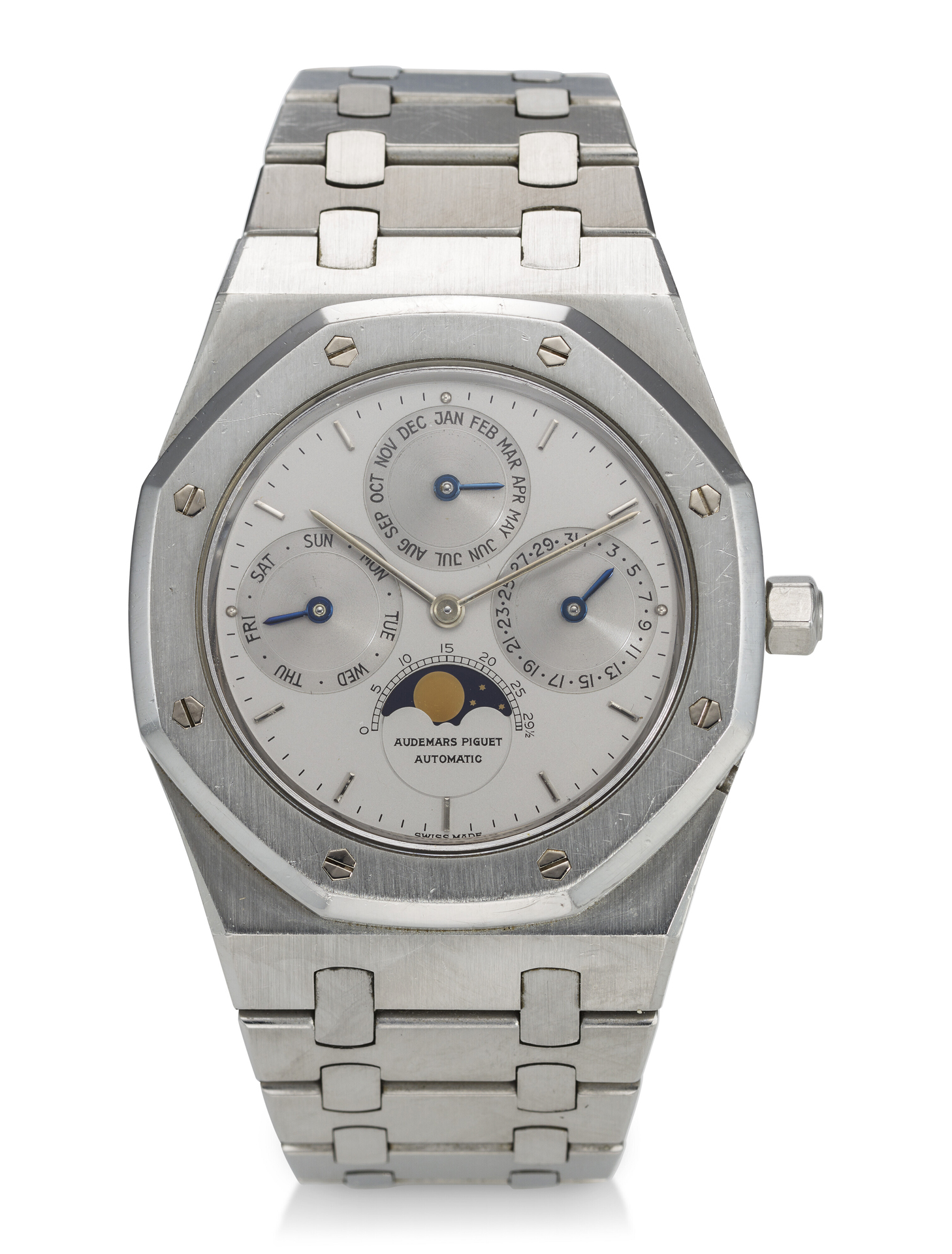
Audemars Piguet Royal Oak Ref. 25554ST, stainless steel, the thinnest Royal Oak perpetual calendar, 1984. Estimate: US$ 150’000-200’000


28.5.23

New releases - Artime ART01

The inaugural model of the newly found brand features a case alternating between transparent sapphire and titanium. Its round shape with monobloc lugs houses a white gold movement with a three-dimensional code, equipped with a one-minute tourbillon regulator and controlled by a function selector. It is 42 mm in diameter, 11.4 mm high and mounted on a black grained calfskin strap with a titanium folding clasp.


23.5.23

Vintage Ads - Repco (1957)

ENGLISH
"Cuffette - Not just an improvement – A thoroughly new watch ". Meant for retailers, this ad guaranteed that the watch set in a cufflink was sure to make an impact on their customers as well as their turnover. The cufflinks were available in a number of different shapes and fitted with “high quality movements”. Repco was a trademark registered by Balmer & Gagnebin from Tramelan in 1944.  
Do you like vintage watch ads? Please visit the page about Watch Ads, my two-volume pictorial history of communication and design in 20th Century watchmaking. You can also watch the video clip about the publication and download a 20-page preview of Volume 1.
The vintage ads presented in this Blog are not featured in the Watch Ads books.


ITALIANO
“Cuffette – Non è solo un’evoluzione – È un orologio di concezione inedita”. Indirizzato ai rivenditori, questo annuncio garantiva che l’orologio inserito in un gemello da polso avrebbe avuto un impatto sicuro sui clienti e dunque sul fatturato del negozio. I gemelli erano disponibili in numerose varianti ed equipaggiati con “movimenti di qualità eccellente”. Repco era un marchio registrato da Balmer & Gagnebin di Tramelan nel 1944.
Ti piacciono le pubblicità d'epoca? Visita la pagina dedicata a Watch Ads, la mia storia illustrata in due volumi della comunicazione e del design nell'orologeria del Novecento. Puoi anche guardare il video sull'opera e scaricare l'anteprima di 20 pagine del Volume 1.
Gli annunci pubblicitari d'epoca presentati in questo Blog non sono inseriti nei volumi Watch Ads.


18.5.23

Vintage press - La Suisse Horlogère (1977)


ENGLISH (il testo italiano è in fondo alla pagina)
La Suisse Horlogère was the official organ of the Swiss Watch Chamber of Commerce. This issue dating back to the Summer of 1977 was mostly devoted to the annual Basle Fair and the trends visitors could observe.


"Never have watches been so beautiful”, claims the title of the main article. Despite the worries about the plunging prices of quartz timepieces, the general mood was rather optimistic. The magazine pointed out that mechanical watches were “better and better still” thanks to caliber standardization, simpler design and higher quality: the newly introduced self-winding movement by Longines was mentioned. At the same time advanced models suggested that Switzerland was at the forefront in electronics as well. The local industry focused on analogue rather than digital watches, estimating that the LCD system was increasingly reserved for multifunctional timepieces.


The following pages feature a few products of the ETA Flatline collection, which included both automatic and quartz calibers. They met the growing demand for ultra-flat watches and super-accurate quartz watches with analogical display.


An interesting five-page report deals with the history of raw-movement production (ébauches) in Switzerland from the beginnings in the 18th Century to the 1970s. 

ITALIANO
La Suisse Horlogère era l’organo ufficiale della Camera di Commercio svizzera dell’orologeria. Questo numero dell’estate 1977 è dedicato principalmente all’annuale Fiera di Basilea e ai trend emersi nel corso della manifestazione. “Gli orologi non sono mai stati così belli”, annuncia il titolo dell’articolo principale. Malgrado le preoccupazioni per i prezzi in picchiata degli orologi al quarzo, l’ambiente manifestava un certo ottimismo. La rivista sottolineava che gli orologi meccanici erano “in continuo miglioramento” grazie alla standardizzazione dei movimenti, alla semplificazione dei progetti e alla qualità più elevata: tra gli esempi si cita il nuovo movimento automatico Longines. Allo stesso tempo la produzione di modelli tecnologicamente avanzati indicava che la Svizzera era all’avanguardia anche nell’elettronica. L’industria locale si andava specializzando negli orologi analogici, stimando che l’affissione digitale si identificasse sempre più con i modelli multifunzione.
Le pagine seguenti mostravano alcune novità della collezione ETA Flatline, comprendente movimenti automatici e al quarzo che rispondevano da una parte alla domanda crescente di orologi extrapiatti, dall’altra a quella di modelli analogici e ultraprecisi al quarzo.
Un interessante servizio di cinque pagine tratta la storia della produzione dei movimenti grezzi (ébauches) in Svizzera dalle origini nel 18esimo secolo agli Anni 70.