26.2.23

New releases – Ralph Lauren Polo Vintage 67


This tribute to the brand’s passion for timepieces from the early 1920s and 1930s features a 40 mm case in aged stainless steel with an onion-shaped crown, and an opaline silver dial with black lacquer Arabic numerals. The boxed sapphire crystal is finished with an anti-reflective treatment. The manual-winding movement (Caliber LJP7380) has a 90-hour power reserve.


19.2.23

Art & Time - La Via del Sangue (Jannis Kounellis, 1973)

ENGLISH (il testo italiano è in fondo alla pagina) 
This post launches a new section of 10e10.ch, devoted to Art in Time and Time in Art. Thanks to exclusive access to the archives of Galleria La Salita, a prominent art gallery in Rome from 1957 to 1998, I will be able to feature works by a few modern and contemporary artists that deal with the favorite subject of this website – time. As it can be expected, they do so in an original, unusual, sometimes puzzling way - the kind of timepieces you never get tired of looking at, even though they do not actually tell the time.

 
The artist’s book titled “La Via del Sangue” is a perfect example of this. Its author is the Greek Italian Jannis Kounellis (1936-2017), the world-famous exponent of Arte Povera, who created it in conjunction with an exhibition titled “Apollo” and held by Galleria La Salita in 1973.


“La Via del Sangue” was published by La Salita and printed by Nazareno Iori from Rome in 290 numbered examples: 250 were offered to the public, 30 were not for sale and 10 were individually signed artist’s proofs.


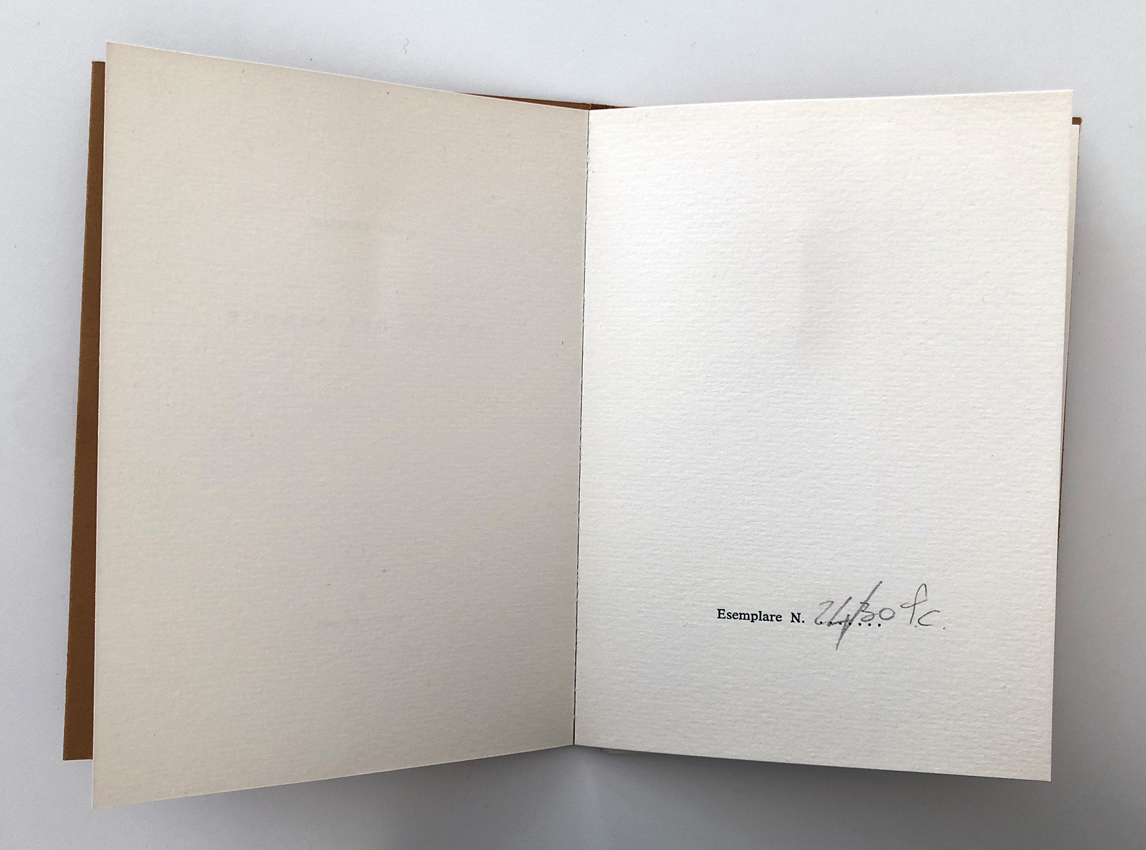
Each booklet was contained in a publisher’s printed slipcase. Its format is 15 x 11 cm (5.9 x 4.3 in.) and the example seen here is number 24/30.
The latest example of "La Via del Sangue" to surface at auction was part of the 1-250 series. It was sold at Finarte / Minerva Auctions on 14 December 2016 for € 3,000.


Why choose “La Via del Sangue” to start the Art & Time section? Because it is a weekly planner, albeit of a very peculiar sort, and as such it relates to time. During the aforementioned exhibition, Kounellis went to the gallery daily, struck a match and mounted it onto paper. 


The result is a booklet featuring seven burnt wood matches, each mounted onto a singed page annotated by the artist himself with a day of the week. The simple act of striking a match to mark each day of the week suggests a ritualized cultural or religious expression, even one of penitence. In this instance, Kounellis is indirectly invoking Apollo, known as the god of light and the sun, to whom the exhibition was dedicated.


Associated with Arte Povera since the 1960s, Jannis Kounellis investigated the alienation inherent in contemporary society, juxtaposing the materials of mass urban and industrial civilization with symbols and values of the pre-industrial world. Incorporating humble non-art materials such as cotton, wool, coal, grain sacks, glass bottles, meat hooks, fire, soot, smoke, bed-frames, doors, shelves, and clothing, Kounellis' work is a melodramatic mixture of installation, environment, performance, and theatrical show.

ITALIANO


Questo post inaugura una nuova sezione di 10e10.ch, dedicata all’Arte nel Tempo e al Tempo nell’Arte. L’accesso esclusivo all’archivio de La Salita, galleria romana di primo piano tra il 1957 e il 1998, mi permetterà di presentare le opere di alcuni artisti moderni e contemporanei che trattano il tema preferito di questo sito: il Tempo. Come si può immaginare, esse lo fanno in modo originale, insolito, a volte sconcertante. Si tratta di “segnatempo” che non ci si stanca mai di guardare, anche se in realtà non dicono che ora è.


Il libro d’artista intitolato “La Via del Sangue” ne fornisce un esempio perfetto. L’autore è il greco-italiano Jannis Kounellis, celebre esponente dell’Arte Povera, che lo creò in occasione della mostra dal titolo “Apollo”, organizzata da La Salita nel 1973. “La Via del Sangue” fu pubblicato da La salita e stampato dalla tipografia Nazareno Iori di Roma in 290 esemplari numerati: 250 in commercio, 30 fuori commercio e 10 prove d’artista firmate. Il libriccino si trovava all’interno di in una custodia di cartoncino sulla quale erano stampati il titolo e il nome dell’autore. Il formato è 15 x 11 cm. L’esemplare presentato in queste foto è il numero 24/30.
L'esemplare de "La Via del Sangue" apparso più recentemente sul mercato faceva parte della serie numerata da 1 a 250. È stato aggiudicato da Finarte / Minerva Auctions il 16 dicembre 2016 per 3.000 Euro.


Perché scegliere “La Via del Sangue” per aprire la sezione Art & Time? Perché si tratta di un agenda settimanale, sia pure di tipo molto particolare, e quindi è in rapporto con il tempo. Durante la mostra citata, Kounellis si recò tutti i giorni presso la Galleria, accese un fiammifero e lo attaccò sulla carta. Il risultato fu un libriccino con sette fiammiferi, ciascuno montato su una pagina bruciacchiata e annotata dall’artista con un giorno della settimana. Il semplice atto di accendere un fiammifero per contrassegnare ogni giorno della settimana suggerisce un’espressione culturale o religiosa ritualizzata, perfino di penitenza. In questo caso, Kounellis sembra invocare indirettamente Apollo, dio della luce e del sole, al quale è dedicata la mostra.


Esponente dell’Arte Povera dagli Anni 60, Jannis Kounellis ha indagato l’alienazione connessa alla società contemporanea, sovrapponendo i materiali della civiltà urbana e industriale di massa ai simboli e ai valori del mondo preindustriale. Caratterizzata dall’uso di materiali umili e non-artistici quali cotone, lana, carbone, sacchi di iuta, bottiglie di vetro, ganci da macellaio, fuoco, fuliggine, fumo, telai da letto, porte, scaffali e abiti, l’opera di Kounellis è una commistione melodrammatica di installazione, ambiente, performance e spettacolo teatrale.


15.2.23

Vintage library - A. Schild (1946)


ENGLISH (il testo italiano è in fondo alla pagina)
In 1946, A. Schild SA (ASSA) celebrated the 50th anniversary from its foundation with a richly illustrated booklet that traced its history as well as that of watchmaking in Granges, the town where the company was based. ASSA was created in 1896 and in 1926 was a founding member of Ebauches SA, the holding that grouped the main Swiss manufacturers of raw movements – 90% of the national output in 1932.


In the 1940s, ASSA employed over 2’000 people and produced as many as 7 million pieces per year in its impressive industrial facilities (see the model above).


The Anniversary booklet includes pictures of both old and contemporary workshops (above), as well as details about the company’s daily life, social security system, workers’ housing, paid vacation days, canteen, library.
The final pages feature several fine color drawings of ASSA’s most successful products, including its first self-winding movements – the caption points out that 350,000 examples of Caliber 1173 (above) were produced since its introduction in 1941.
  
ITALIANO 
Nel 1946, A. Schild SA (ASSA) celebrò il 50esimo anniversario dalla fondazione pubblicando un libro riccamente illustrato che ripercorreva la sua storia insieme con quella dell’orologeria a Granges, cittadina dove aveva sede la ditta. ASSA fu creata nel 1896 e nel 1926 fu tra i membri fondatori di Ebauches SA, la holding che raggruppava i più importanti costruttori svizzeri di movimenti grezzi: 90% della produzione nazionale nel 1932.
Negli Anni 40, ASSA aveva oltre 2.000 dipendenti che producevano 7 milioni di pezzi l’anno nel suo impressionante complesso industriale (vedi il plastico, seconda foto dall'alto).
Il libro dell’anniversario comprende foto di laboratori d’epoca e contemporanei (terza foto dall'alto), nonché dettagli sulla vita quotidiana della compagnia, sul sistema di previdenza sociale e delle vacanze pagate, sugli alloggi edificati per i dipendenti, sulla mensa e sulla biblioteca aziendale.
Le pagine finali contengono i diagrammi a colori dei prodotti ASSA di maggior successo, compresi i primi movimenti automatici. La didascalia sottolinea che il Calibro 1173 (quarta foto dall'alto) è stato prodotto in 350.000 esemplari dalla sua creazione del 1941.


11.2.23

New releases - Nivada Grenchen x Undone Depthmaster


Undone partners with watch brand Nivada Grenchen to create a collection inspired by 1980s arcade games and art-deco aesthetics. The Depthmaster /Pixel Art edition is limited to 200 pieces. The stainless steel case hosts an automatic movement and is water resistant up to 100ATM (1,000 metres).

5.2.23

Video - Orologio da tavolo (Anni 1920)


Dal Canale YouTube di 10e10.ch: una pendoletta Art Deco con movimento svizzero e cassa d'argento americana.


1.2.23

Vintage Ads - Rado (1963)

ENGLISH (il testo italiano è sotto l'immagine)
"A revolutionary watch in the top Swiss quality – DiaStar is the only watch in the world that preserves its eternal shining beauty ". Scratchproof, waterproof, accurate: the self-winding timepiece launched in 1962 by the manufacturer from Lengnau would go on to become the company’s best-selling product for a decade.
Do you wish to know more about it? Then The Museum Collection is a must-read for you. My book about 100 milestones of 20th Century watchmaking features 2 pages about the DiaStar. Watch the video clip about the book and download the 20-page preview.           
Do you like vintage watch ads? Visit the page about Watch Ads, my two-volume pictorial history of communication and design in 20th Century watchmaking. Do you wish to know more? Watch the video clip about the publication and download the preview of Volume 1.
The vintage ads presented in this Blog are not featured in the Watch Ads books.


ITALIANO
“Un orologio rivoluzionario della migliore qualità svizzera – DiaStar è l’unico orologio del mondo che conserva per sempre la sua lucente bellezza”. Inscalfibile, impermeabile preciso: l’automatico lanciato nel 1962 dalla Casa di Lengnau sarebbe diventato il suo prodotto di maggiore successo nei dieci anni seguenti.
Vuoi saperne di più? Allora Orologi da polso 1960-2000 è la lettura che fa per te. Il secondo volume della mia storia enciclopedica dell'orologio da polso contiene 2 pagine sul DiaStar. Scarica l’anteprima di 20 pagine.
Ti piacciono le pubblicità d'epoca? Visita la pagina su Watch Ads, la mia storia illustrata in due volumi della comunicazione e del design nell'orologeria del Novecento. Vuoi saperne di più? Guarda il video sull'opera e scarica l'anteprima del Volume 1.
Gli annunci pubblicitari d'epoca che vedi in questo Blog non sono presentati nei volumi Watch Ads.


25.1.23

New releases – Lang & Heyne Friedrich II Remontoir

This timepiece celebrates the 9-year partnership between the German brand and The Lavish Attic. It features a two-part enamel dial made of enamel block, and a manual-wind movement (Caliber VI-I) equipped with the ‘Remontoir’ constant force mechanism that keeps the amplitude of the balance wheel constant throughout the day. The movement plate, gear bridge, lever bridge and balance cock are manufactured of medium-hard titanium of purity grade 2. The 39.2 mm case is available in stainless steel, rose gold, white gold, and platinum.