11.1.23

New releases – Régulateur Louis Erard x Label Noir

  
This timepiece was born from the meeting between the Louise Erard brand and the Geneva-based atelier Label Noir, specialising in customisation. The latter redesigned the regulator in its own way of reading the time: first the hour, then the minute, then the seconds. This order led to graduated finishes, from true matte to a glossy sheen. The 42 mm sandblasted steel case with black PVD coating houses the self-winding caliber Sellita SW266-1 (38-hour power reserve). Limited edition of 178 pieces, retail price CHF 3,500.


27.10.22

Vintage ads - Ciny (1939)

ENGLISH (il testo italiano è sotto l'immagine)
"For the city – For swimming – For sports – For staff nurses”. This ad emphasised that the Ciny catalog offered timepieces suitable for a wide range of activities.       
Do you like vintage watch ads? Please visit the
page about Watch Ads, my two-volume pictorial history of communication and design in 20th Century watchmaking. You can also watch the video about the publication and download a 20-page preview
of Volume 1.
The vintage ads presented in this Blog are not featured in the Watch Ads books.
 

ITALIANO 
"Per la città – Per il nuoto – Per lo sport – Per l’infermiera”. Questo annuncio sottolineava che il catalogo Ciny presentava orologi adatti per una vasta gamma d’attività.
Ti piacciono le pubblicità d'epoca? Visita la pagina su Watch Ads, la mia storia illustrata in due volumi della comunicazione e del design nell'orologeria del Novecento. Puoi anche guardare il video sull'opera e scaricare l'anteprima di 20 pagine del Volume 1.Gli annunci pubblicitari d'epoca presentati in questo Blog non sono inseriti nei volumi Watch Ads.


16.10.22

Historic timepieces - Churchill's watch

ENGLISH (il testo italiano è sotto la foto)  
This pocket watch was made in 1818 by Breguet and purchased in 1890 by John Spencer-Churchill, the 7th Duke of Marlborough. Later on, it was worn by the most famous of his descendants, Winston Churchill, who called it "the Turnip". It is a yellow gold minute repeater with a split-second chronograph whose serial number is 765. Its current owner is Randolph Churchill, the great grandson of the former British Prime minister.  
I took this picture a few years ago, while visiting the Churchill War Rooms in London. The caption seen at the bottom of the display window is incorrect - the timepiece is a split-second rather than flyback chronograph and entered the Churchill family in 1890 rather than 1818. 
The Oscar-winning actor Gary Oldman wore a Breguet-made replica of the Turnip in the movie "Darkest Hour" (2017). That timepiece is different from the original one, which does not feature the brand's name on the dial.
 
 
ITALIANO 
Questo orologio da tasca Breguet fu acquistato nel 1890 da John Spencer-Churchill, settimo Duca di Marlborough. In seguito fu indossato dal più celebre dei suoi discendenti, Winston Churchill, che lo battezzò "la Cipolla". Si tratta di una ripetizione minuti d'oro giallo con cronografo sdoppiante, il cui numero seriale è 765. L'attuale proprietario è Randolph Churchill, bisnipote dell'ex Primo ministro britannico. 
Ho scattato la foto qualche anno fa, durante una visita al museo Churchill War Rooms di Londra. Alcune delle informazioni riportate dalla targhetta visibile in fondo alla vetrina sono inesatte: l'orologio è un cronografo sdoppiante (non flyback) ed è proprietà della famiglia Churchill dal 1890 (non 1818). 
L'attore premio Oscar Gary Holdman ha indossato una replica della "Cipolla" creata da Breguet per il film "L'ora più buia". Il pezzo è diverso dall'originale, che non aveva il nome del fabbricante sul quadrante.


3.10.22

Vintage Celebrities - Louis Armstrong (1956)

ENGLISH
In 1956, Louis Armstrong and his band successfully toured Switzerland. His fans of the Hot Club from Neuchâtel gifted him with a gold self-winding timepiece by Ernest Borel. The great American trumpeter, composer and vocalist is seen here fastening the watch to his wrist.


ITALIANO
Nel 1956 Louis Armstrong e il suo gruppo effettuarono una tournée di successo in Svizzera. I suoi fan dell’Hot Club di Neuchâtel gli fecero dono di un automatico d’oro firmato Ernest Borel. Nella foto, il grande trombettista, compositore e cantante americano si allaccia l’orologio al polso.


14.9.22

Vintage Press - Journal Suisse d'Horlogerie (1967)


ENGLISH (il testo italiano è in fondo alla pagina)
The cover of this magazine dating back to 1967 features a view of the Basel exhibition center, venue of the Swiss Watch Show since the early 1930s. As the official publication of the event, the Journal Suisse d’Horlogerie (Swiss Watchmaking Magazine) published a full 20 pages guide for professional visitors that included the list of exhibitors and their stands’ location.

The editorial dealt with a statement made in 1966 by Mr Yamada, Citizen’s chairman, according to which Japan would become the world’s top watch manufacturing country in five years’ time. Should Switzerland worry about its Asian competitor? Yes and No was the answer. The current growth rhythm suggested that the five-year goal was unrealistic. As for the future, it would depend on research, development and marketing. (Japan would indeed get the top rank in 1977, only to lose it to Hong Kong one year later).

The section about selling techniques features the second instalment of what we would now call the buyer’s FAQs and the relevant answers. The main subjects were the watches’ accuracy and price, but topics such as the luminescent dials, shock absorbers and guarantee certificates were also dealt with.


Shopwindows being essential points of attraction for potential customers, the magazine offered a few tips on how to set them up. The wrong way to do that is found at the top left of the page. The two drawings on the right-hand side feature nice-looking stores.   

ITALIANO
Sulla copertina di questa rivista del 1967 troviamo una panoramica del centro espositivo di Basilea, sede della Fiera svizzera dell’orologeria fin dall’inizio degli Anni 30. Organo ufficiale della manifestazione, il Journal Suisse d’Horlogerie (Rivista svizzera dell’orologeria) pubblica una guida di 20 pagine destinata ai visitatori professionali, comprendente la lista degli espositori e l’ubicazione dei rispettivi stand.
L’editoriale (seconda foto dall’alto) è dedicato a una dichiarazione resa nel 1966 da Eiichi Yamada, presidente di Citizen, secondo la quale il Giappone diventerà il primo produttore mondiale d’orologi nel giro di cinque anni. La Svizzera deve preoccuparsi del suo concorrente asiatico? Sì e No, è la risposta. L’attuale ritmo di crescita sembra indicare che l’obiettivo dei cinque anni non è realistico. In quanto al futuro, dipenderà da fattori come la ricerca, lo sviluppo e il marketing. (nel 1977 il Giappone diventerà davvero il numero 1 mondiale, ma perderà il primato un anno dopo a favore di Hong Kong, ndr).
Nella sezione sulle tecniche di vendita (terza foto dall'alto) troviamo la seconda puntata di quelle che al giorno d’oggi chiameremmo le FAQ (domande frequenti) del compratore e le relative risposte. I temi principali sono la precisione e il prezzo degli orologi, ma c’è spazio anche per argomenti come i quadranti luminescenti, i dispositivi antiurto e i certificati di garanzia.
Visto che la vetrina è un richiamo importante per i potenziali compratori, la rivista offre qualche consiglio sull’allestimento. In alto a sinistra (foto in basso) c’è un esempio da non seguire. I due disegni sulla destra mostrano punti vendita attraenti.


8.9.22

Vintage ads - Doxa (1945)

ENGLISH (il testo italiano è sotto l'immagine)
"At the peak of perfection – Self-winding – Antimagnetic – Waterproof”. Doxa chose climbing, a typical Swiss activity, to highlight the reliability and sturdiness of its sports watches.       
Do you like vintage watch ads? Please visit the
page about Watch Ads, my two-volume pictorial history of communication and design in 20th Century watchmaking. You can also watch the video about the publication and download a 20-page preview of Volume 1. 
The vintage ads presented in this Blog are not featured in the Watch Ads books.
 
 
ITALIANO
"In vetta alla qualità – Automatico – Antimagnetico – Impermeabile”. Doxa ha scelto l’alpinismo, tipica attività svizzera, per evidenziare l’affidabilità e la robustezza dei suoi modelli sportivi.
Ti piacciono le pubblicità d'epoca? Visita la
pagina su Watch Ads, la mia storia illustrata in due volumi della comunicazione e del design nell'orologeria del Novecento. Puoi anche guardare il video sull'opera e scaricare l'anteprima di 20 pagine del Volume 1.
Gli annunci pubblicitari d'epoca presentati in questo Blog non sono inseriti nei volumi Watch Ads.


10.7.22

Vintage Ads - Omega (1930s)

ENGLISH (il testo italiano è sotto l'immagine)
"Supreme elegance – Omega – Nothing is more accurate". This gorgeous example of an Art Deco ad aimed at drawing the attention of sports automobile drivers. The latter would surely be attracted by the sturdy-looking watch and chronograph made of stainless steel, the latest development in case making.
Do you like vintage watch ads? Please visit the page about Watch Ads, my two-volume pictorial history of communication and design in 20th Century watchmaking. You can also watch the video about the publication and download a 20-page preview of Volume 1.
The vintage ads presented in this Blog are not featured in the Watch Ads books. 
 

ITALIANO
"Eleganza suprema – Omega – Nulla è più preciso”. Questo splendido esempio di annuncio Art Deco si dirigeva ai conducenti di auto sportive, che avrebbero certamente apprezzato l’aspetto robusto dell’orologio e del cronografo d’acciaio, ultima novità in fatto di casse.
Ti piacciono le pubblicità d'epoca? Visita la pagina su Watch Ads, la mia storia illustrata in due volumi della comunicazione e del design nell'orologeria del Novecento. Puoi anche guardare il video sull'opera e scaricare l'anteprima di 20 pagine del Volume 1.
Gli annunci pubblicitari d'epoca presentati in questo Blog non sono inseriti nei volumi Watch Ads.


25.6.22

Vintage Press - La Suisse Horlogère (1962)


ENGLISH (il testo italiano è in fondo alla pagina)
La Suisse Horlogère was a quarterly trade magazine that usually devoted each issue to a single subject. The last issue of 1962 dealt with the different levels of testing adopted by the Swiss watchmaking industry.

The newly introduced technical control of watches met the demand for an institutional measure intended to protect the reputation of the national industry. An official body was charged to select a few watches and movements destined for export and to carry out an inspection in order to ensure that they met certain technical standards. Made compulsory for all Swiss manufacturers in January 1962, this control affected less than 1% of watches.


The testing at the Swiss Observatories of Geneva and Neuchâtel (on the left in the photo above) was related to the precision competitions held by the two institutions. The top brands and watchmakers took part in such events with specially made and adjusted movements, and turned them into celebrations of the Swiss industry, as well as into excellent marketing tools.


The official Swiss testing agencies had a very different task, in that no direct competition between manufacturers was involved. The submitted pieces that met the guidelines set by the agencies were issued precision certificates and could be marketed as “chronometers”.

ITALIANO
La Suisse Horlogère era una rivista specializzata trimestrale che generalmente dedicava ogni uscita a un argomento unico. L’ultimo numero del 1962 trattava i diversi livelli di controllo adottati dall’industria orologiera svizzera.
Appena entratro in vigore, il controllo tecnico degli orologi (seconda foto dall’alto) soddisfava la richiesta di una misura istituzionale finalizzata a proteggere la reputazione dell’industria elvetica. Un organo ufficiale fu incaricato di selezionare un campione di orologi e movimenti destinati all’esportazione e di analizzarne la compatibilità con determinati requisiti tecnici. Obbligatorio per tutti i fabbricanti svizzeri a partire dal gennaio del 1962, il controllo riguardava meno dell’1% dei prodotti.
I test condotti presso gli Osservatori di Ginevra e Neuchâtel (pagina di sinistra nella terza foto dall’alto) si riferivano ai concorsi di precisione organizzati dai due istituti. Alle competizioni partecipavano le marche e i tecnici più importanti, che presentavano movimenti costruiti e regolati individualmente. Queste celebrazioni pubbliche dell’industria svizzera fungevano anche da formidabie strumento promozionale.
Le agenzie ufficiali svizzere avevano un compito molto diverso, nel senso che non c’era competizione diretta tra i fabbricanti (quarta foto dall’alto). I pezzi che rimanevano entro i margini d'errore fissati dal regolamento ricevevano un certificato di precisione e potevano essere commercializzati con la denominazione di “cronometrri”.


11.6.22

Vintage Ad - Incastar (1949)

ENGLISH (il testo italiano è sotto l'immagine)
"A revolutionary devolopment in regulation ... After the Incabloc, Universal Escapement Ltd. now offers a new and important development". Patented by Fritz Marti - inventor of the Incabloc shock absorber - the Incastar device guaranteed long-period stability to the running rate of movements.
Do you like vintage watch ads? Please visit the page about Watch Ads, my two-volume pictorial history of communication and design in 20th Century watchmaking. You can also watch the video about the publication and download a 20-page preview of Volume 1.
The vintage ads presented in this Blog are not featured in the Watch Ads books.


ITALIANO
"Una novità rivoluzionaria nella regolazione ... Dopo l'Incabloc, Universal Escapement SA presenta un perfezionamento nuovo e importante". Brevettato da Fritz Marti - l'inventore dell'antiurto Incabloc - il dispositivo Incastar garantiva stabilità durevole alla marcia del movimento. Il volume Orologi da polso 1900-1959 presenta un Ernest Borel equipaggiato con l'Incastar a pagina 300, illustrandone le caratteristiche.
Ti piacciono le pubblicità d'epoca? Visita la pagina su Watch Ads, la mia storia illustrata in due volumi della comunicazione e del design nell'orologeria del Novecento. Puoi anche guardare il video sull'opera e scaricare l'anteprima di 20 pagine del Volume 1.
Gli annunci pubblicitari d'epoca presentati in questo Blog non sono inseriti nei volumi Watch Ads.


8.5.22

Vintage library - The high-frequency watch (early 1970s)


ENGLISH
(il testo italiano è in fondo alla pagina)
 
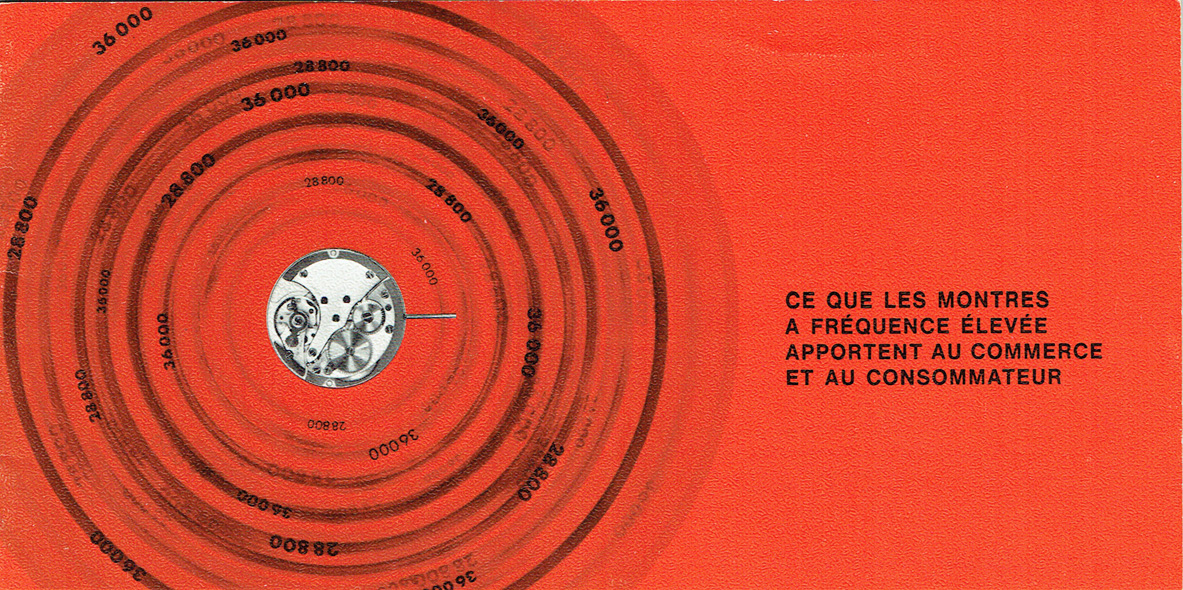
“What high frequency timepieces bring to the retailer and the consumer”. The Swiss committee for the promotion of the high frequency watch published this booklet in the early 1970s. Its aim was to emphasise the advantages of the movements equipped with a balance wheel oscillating at 36,000 vibrations per hour (10 times per second). Girard-Perregaux was the first manufacturer to adopt the fast beat escapement patented by the Fabriques d’Assortiments Réunies (FAR) in 1965, and several competitors followed suit.
 

The brochure points out that the 36,000vph frequency guarantees an increased accuracy as compared to the 18,000vph of an ordinary movement, as well as a better rate stability, shock resistance, and long-term reliability due to the dry lubrication system. 
 

The popularity of high-frequency movements lasted for only about a decade, after which time the falling prices and unsurpassable accuracy of quartz watches overshadowed their main selling points. The most notable survivor of the fast-beat era is El Primero, the chronograph movement by Zenith whose frequency enables to time events to the tenth of a second.
 

ITALIANO
“Cosa offre l’alta frequenza al commerciante e al consumatore”. Il comitato svizzero per la promozione dell’orologio ad alta frequenza pubblicò questo opuscolo nei primi Anni 70. Il suo scopo era sottolineare i vantaggi dei movimenti equipaggiati con il bilanciere che oscillava a 36.000 alternanze/ora (10 semioscillazioni secondo). Girard-Perregaux fu il primo fabbricante ad adottare lo scappamento ultrarapido brevettato dalle Fabriques d’Assortiments Réunies (FAR) nel 1965, imitato in breve da numerosi concorrenti.
La brochure fa notare che la frequenza di 36.000a/o garantisce una precisione superiore alle 18.000 a/o di un movimento standard, oltre a prestazioni migliori in termini di stabilità, resistenza agli urti e affidabilità a lungo termine grazie al sistema di lubrificazione a secco.
Il successo dell’alta frequenza durò poco più di un decennio, poi i prezzi calanti e la precisione insuperabile del quarzo misero in ombra i suoi argomenti commerciali più importanti. Il sopravvissuto più famoso di quel periodo è El Primero, il movimento cronografico Zenith che grazie alla sua frequenza permette di misurare tempi parziali con una precisione al decimo di secondo.


6.4.22

Vintage gadgets - Mido (1970s)

ENGLISH
A display plaque for the shopwindow of an official Mido retailer. Described as the “King of waterproof watches”, the Ocean Star was introduced in 1959. Aquadura was the name of its crown sealing system.


ITALIANO  
Una targhetta metallica per la vetrina di un rivenditore ufficiale Mido. Presentato come il “Re degli orologi impermeabili”, l’Ocean Star fu lanciato nel 1959. Aquadura era il nome del suo sistema di chiusura stagna per la corona.


24.3.22

Vintage press - Journal Suisse d'Horlogerie (1972)

ENGLISH (il testo italiano è in fondo alla pagina) 
Largely devoted to the Swiss Watch Fair in Basel, this 1972 issue of the Journal Suisse d’Horlogerie features an illustrated review of the event.

These pages introduce a few products that are familiar faces to modern day collectors, such as the Movado Museum Watch and the Zenith El Primero.

Fashion watches are the subject of a six-page report that deals with the models by Bulova. Jean-Samuel Wuhl designed the ladies timepiece seen here, an Accutron whose battery is housed in an element of the bracelet. His creation was awarded the 1971 Geneva prize.

The survey about shop windows decorations features the works of, among others, Mrs Mamie for Vacheron et Constantin (page’s top photo) and Mrs Schmid for Rolex (pictures 5, 6 and 7).

ITALIANO
Dedicata in buona parte alla Fiera svizzera dell’orologeria di Basilea, questa rivista del 1972 contiene un ampio reportage illustrato sull’evento. Queste pagine sono dedicate ad alcuni modelli che hanno un aspetto familiare per i collezionisti di oggi, tra i quali il Museum Watch di Movado e El Primero di Zenith.
Gli orologi di design sono l’argomento di un servizio di sei pagine che tratta i modelli Bulova. Jean-Samuel Wuhl è il creatore di questo esemplare, un Accutron con pila alloggiata in un elemento del bracciale che si è aggiudicato il Premio Città di Ginevra nerl 1971.
La rassegna dedicata alle decorazioni delle vetrine presenta i contributi, fra gli altri, della signora Mamie per Vacheron et Constantin (foto in alto) e della signora Schmid per Rolex (foto 5, 6 e 7).


9.1.22

Vintage ad - Girard-Perregaux

ENGLISH (il testo italiano è sotto l'immagine)
"A record - 662 Observatory certificates put Girard-Perregaux at the forefront of the international masters of chronometry". This ad dating back to 1967 celebrates the results achieved by the manufacturer in the demanding tests set up by the Neuchâtel Observatory. 662 Girard-Perregaux standard production Chronometers HF were issued the institution's accuracy certificates - an unprecedented deed. They all featured the Clinergic 21 escapement, whose frequency of 36,000 vibrations per hour was the world's highest at the time.
Interested in vintage watch ads? Please visit the page about my recent release - Watch Ads 1900-2000, a two-volume pictorial history of communication and design in 20th Century watchmaking.
Click here to display and download the 20-page preview.
Please note that the vintage ads presented in this Blog are not featured in the Watch Ads books.
 

ITALIANO
"Un record: 662 certificati d'Osservatorio elevano Girard-Perregaux al vertice dei maestri internazionali della cronometria". Questo annuncio del 1967 celebra i risultati conseguiti dalla Casa negli impegnativi test organizzati presso l'Osservatorio di Neuchâtel. 662 Chronometers HF Girard-Perregaux di produzione standard guadagnarono il certificato di precisione della prestigiosa istituzione, un exploit senza precedenti. Tutti erano dotati di movimento con scappamento Clinergic 21, la cui frequenza di 36.000alternanze/ora era allora la più alta del mondo. 
Ti piacciono le pubblicità d'epoca? Visita la pagina su Watch Ads 1900-2000, la mia storia illustrata in due volumi della comunicazione e del design nell'orologeria del Novecento.  
Clicca qui per visualizzare e scaricare un'anteprima di 20 pagine.  
Gli annunci pubblicitari d'epoca presentati in questo Blog non sono inseriti nei volumi Watch Ads. 


12.12.21

Vintage Press - Journal Suisse d'Horlogerie (1956)


ENGLISH (il testo italiano è in fondo alla pagina)
As the cover of this 1956 edition of the Swiss Watchmaking Magazine suggests, the main feature deals with the rating certificates issued by the Swiss official testing agencies.


Its purpose is to inform retailers and their staff about the testing procedures and the meaning of their results, so that they pass on these explanations to customers.


The report on the “Montres et Bijoux” exhibition held in Geneva features a number of jewelry watches for ladies – such timepieces played a crucial role in the industry’s turnover.


In view of the upcoming Christmas gifts season, the magazine offers a few tips to shopkeepers on how to decorate their shop windows and make them attractive to passers-by.

ITALIANO 
Come indica la copertina di questo Journal Suisse d’Horlogerie del 1956, la sezione principale tratta i certificati di precisione rilasciati dalle agenzie svizzere di controllo ufficiali. Lo scopo è informare i commercianti e il loro personale di vendita sulle procedure di controllo e sul significato dei loro risultati, in modo che possano trasmettere queste spiegazioni ai clienti.
Il reportage sulla recente mostra “Montres et Bijoux” di Ginevra presenta numerosi orologi gioiello per signora: questi prodotti hanno un peso determinante nel fatturato delle Case.
In vista dell’imminente stagione dei regali natalizi, la rivista offre qualche consiglio ai rivenditori su come allestire le vetrine per renderle più attraenti.