11.6.22

Vintage Ad - Incastar (1949)

ENGLISH (il testo italiano è sotto l'immagine)
"A revolutionary devolopment in regulation ... After the Incabloc, Universal Escapement Ltd. now offers a new and important development". Patented by Fritz Marti - inventor of the Incabloc shock absorber - the Incastar device guaranteed long-period stability to the running rate of movements.
Do you like vintage watch ads? Please visit the page about Watch Ads, my two-volume pictorial history of communication and design in 20th Century watchmaking. You can also watch the video about the publication and download a 20-page preview of Volume 1.
The vintage ads presented in this Blog are not featured in the Watch Ads books.


ITALIANO
"Una novità rivoluzionaria nella regolazione ... Dopo l'Incabloc, Universal Escapement SA presenta un perfezionamento nuovo e importante". Brevettato da Fritz Marti - l'inventore dell'antiurto Incabloc - il dispositivo Incastar garantiva stabilità durevole alla marcia del movimento. Il volume Orologi da polso 1900-1959 presenta un Ernest Borel equipaggiato con l'Incastar a pagina 300, illustrandone le caratteristiche.
Ti piacciono le pubblicità d'epoca? Visita la pagina su Watch Ads, la mia storia illustrata in due volumi della comunicazione e del design nell'orologeria del Novecento. Puoi anche guardare il video sull'opera e scaricare l'anteprima di 20 pagine del Volume 1.
Gli annunci pubblicitari d'epoca presentati in questo Blog non sono inseriti nei volumi Watch Ads.


5.6.22

New releases - Doxa Army

Between 1968 and 1975, Swiss Army combat divers were equipped with a Doxa Sub 300T Professional. It was the same watch as the one launched in 1967, with a few modifications meant to eliminate any risk of glare: the matte black case and insert diving bezel, and the sand-beige dial. Now the company reissues a 100 pieces edition of the model in collaboration with its partner Watches of Switzerland. The new Doxa Army features a matte black ceramic case rather than stainless-steel case blackened by oxidation of its predecessor, and a self-winding movement.


1.6.22

Dream watches - Patek Philippe Ref. 1436

Favoloso cronografo rattrapante del 1939. Video realizzato da Hora, Associazione Italiana di Cultori dell'Orologeria Antica con sede a Milano.


A fabulous split-second chronograph dating back to 1939. Video clip by Hora, the Milan-based Italian Association of Antique Watches Lovers (language: Italian).

27.5.22

Arriva Orologi da polso 1960-2000!


Ecco la copertina di Orologi da polso 1960-2000 sul banco del tecnico incaricato di controllare la qualità della stampa. La tipografia ha appena finito di stampare il volume che completa la storia di un secolo di orologi da polso avviata con la pubblicazione di Orologi da polso 1900-1959. Come sanno i lettori di quest'ultimo, si tratta di un'opera unica nel panorama editoriale internazionale, che con le 432 pagine di questa seconda parte arriva a un totale di 864. La ricostruzione storica, le schede tecniche e le curiosità sono accompagnate complessivamente da circa 2500 immagini comprendenti le foto di circa 800 orologi e le riproduzioni di cataloghi, manuali, brevetti e annunci pubblicitari. Orologi da polso 1960-2000 si chiude con un'appendice sull'evoluzione della tecnica e dello stile tra il 2001 e il 2021. Clicca qui per saperne di più e scaricare l'anteprima di 20 pagine in formato PDF.
Attualmente le pagine si trovano presso la legatoria che provvede alla confezione finale. I libri saranno disponibili tra la fine di giugno e l'inizio di luglio presso le librerie e gli shop online. I lettori noteranno che, benché il numero di pagine sia lo stesso del primo volume, il prezzo è più alto: 190 Euro invece di 170. Questo si deve ai costi in crescita esponenziale che hanno interessato tutte le materie prime, tra cui la carta. L'editore ha deciso di andare incontro al lettore assorbendo il 50% dell'aumento, mentre il resto si ripercuote inevitabilmente sul prezzo al pubblico.   
 

23.5.22

The One-of-A-Kind exhibition

Never before has such an important private watch collection been revealed to the public. The London’s Design Museum is currently hosting the best of the OAK collection – 168 of the over 600 exceptional pieces owned by the French businessman Patrick Getreide (pictured above), who acquired them over the span of 40 years. The collection almost exclusively features One-of-A-Kind watches (hence the acronym OAK), produced in limited series as special edition or on special order. It also includes many items worthy of being showcased in museums. 

Among the latter are the timepieces that once belonged to Henry Graves Jr, the American banker and railroad tycoon who commissioned 39 watches from Patek Philippe. Thirteen of them are currently on display at the company’s Museum, whilst Mr Getreide is the world’s only private collector who owns five. Above, the platinum-cased tourbillon pocket watch that won the Geneva Astronomical Observatory Timing Contest in 1933. 

The Rare Handcrafts section of the exhibition features pieces such as this Patek Philippe Ref. 2481 with “cloisonné” enamelled dial.

Among the Rolex Sports Chronographs is the 1966 Cosmograph Daytona with Paul Newman dial that belonged to the NASA astronaut Walter Cunningham, who occupied the Lunar Module Pilot seat for the flight of Apollo 7, the first launch of a crewed Apollo mission.


The London stage of the OAK Collection travelling exhibition runs until May 25. It will then move to Bahrain, China and the USA.


18.5.22

An historic timepiece

 
The catalog of next month’s Christie’s auction – New York, 8-9 June – features several timepieces that will sell for more than this Rolex chronograph Ref. 3525, but none of them can claim a comparable history. 
Its original owner was RAF Flight Lieutenant Gerald Imeson, who had it delivered to the Stalag Luft III prisoner-of-war (POW) camp in 1942. He ordered it from the company itself, whose founder Hans Wilsdorf offered British POWs the chance to buy Rolex watches on credit, allowing them to pay when the war was over. Having been captured after his Wellington bomber was hit by flak, Imeson had his watch seized by the Germans. Once moved to the camp, he became one of the 3,000 British servicemen who ordered a Rolex watch, and not an ordinary one – this chronograph was the first one to feature a waterproof Oyster case with screw-down crown, and one of the catalog’s most expensive timepieces.
  

Imeson is the fourth from left in this picture of British POWs at the Stalag Luft III camp. He wore his Ref. 3525 chronograph while taking part in the episode celebrated by the 1963 film The Great Escape, starring Steve McQueen. He and his comrades built three 30ft deep tunnels that were expected to allow for 200 men to escape from the camp. Iveson was allocated position 172 in the queue, but never made it into the tunnels as the German guards discovered the break-out. 73 of the 76 escapees were captured and 50 of them executed. It was a war crime that led to an investigation and a trial after the war: 13 of the 18 defendants received death sentences.
 
Imeson wore his Rolex during the marches forced on the POWs as the Germans evaded the advancing Russians in early 1945. He survived and was eventually liberated from another camp in May. He only paid for the watch two years after the war because of British currency restrictions. The price was £ 170, the equivalent of £ 6,000 today. 


The picture above features Imeson and his wife in the 1980s. He is wearing his Rolex chronograph, an object he treasured until he died in 2003 aged 85. His last wishes were for it to one day be sold so his family could benefit. In 2013 his grandchildren entrusted it to a British auction house, which sold it for £ 50,000. Christie’s estimate for the upcoming auction is $ 200,000-400,000.


8.5.22

Vintage library - The high-frequency watch (early 1970s)


ENGLISH
(il testo italiano è in fondo alla pagina)
 
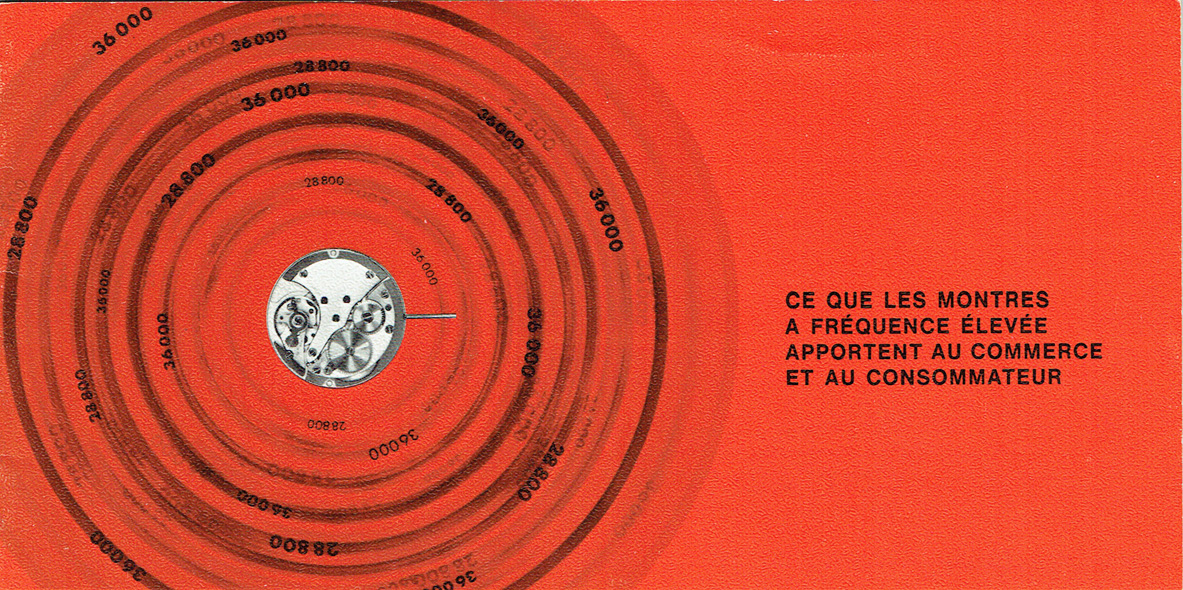
“What high frequency timepieces bring to the retailer and the consumer”. The Swiss committee for the promotion of the high frequency watch published this booklet in the early 1970s. Its aim was to emphasise the advantages of the movements equipped with a balance wheel oscillating at 36,000 vibrations per hour (10 times per second). Girard-Perregaux was the first manufacturer to adopt the fast beat escapement patented by the Fabriques d’Assortiments Réunies (FAR) in 1965, and several competitors followed suit.
 

The brochure points out that the 36,000vph frequency guarantees an increased accuracy as compared to the 18,000vph of an ordinary movement, as well as a better rate stability, shock resistance, and long-term reliability due to the dry lubrication system. 
 

The popularity of high-frequency movements lasted for only about a decade, after which time the falling prices and unsurpassable accuracy of quartz watches overshadowed their main selling points. The most notable survivor of the fast-beat era is El Primero, the chronograph movement by Zenith whose frequency enables to time events to the tenth of a second.
 

ITALIANO
“Cosa offre l’alta frequenza al commerciante e al consumatore”. Il comitato svizzero per la promozione dell’orologio ad alta frequenza pubblicò questo opuscolo nei primi Anni 70. Il suo scopo era sottolineare i vantaggi dei movimenti equipaggiati con il bilanciere che oscillava a 36.000 alternanze/ora (10 semioscillazioni secondo). Girard-Perregaux fu il primo fabbricante ad adottare lo scappamento ultrarapido brevettato dalle Fabriques d’Assortiments Réunies (FAR) nel 1965, imitato in breve da numerosi concorrenti.
La brochure fa notare che la frequenza di 36.000a/o garantisce una precisione superiore alle 18.000 a/o di un movimento standard, oltre a prestazioni migliori in termini di stabilità, resistenza agli urti e affidabilità a lungo termine grazie al sistema di lubrificazione a secco.
Il successo dell’alta frequenza durò poco più di un decennio, poi i prezzi calanti e la precisione insuperabile del quarzo misero in ombra i suoi argomenti commerciali più importanti. Il sopravvissuto più famoso di quel periodo è El Primero, il movimento cronografico Zenith che grazie alla sua frequenza permette di misurare tempi parziali con una precisione al decimo di secondo.